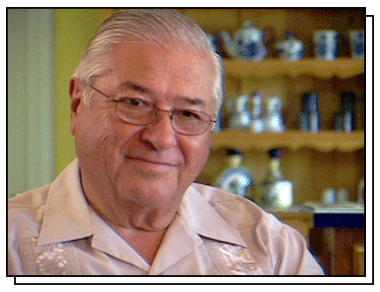
Herman Gallegos
Herman Gallegos was working his way through college as a gas station attendant in San Jose when he first became involved in the Community Service Organization. His early exposure to the organizing power of CSO fueled his passion for community activism. He has pursued his commitment to empowering Mexican Americans and other disenfranchised minorities ever since, in a variety of venues.
In 1960, at the age of 25, Gallegos became president of the National Community Service Organization. He moved from community-based organizing to pioneering work with non-profit organizations and foundations. Gallegos was a founder and first Executive Director of what is now the National Council of La Raza, and one of the first Hispanics elected to serve on the boards of publicly traded corporations. He also served on the boards of philanthropic organizations and foundations including the Rosenberg Foundation, the Rockefeller Foundation and the California Endowment. He has received five Presidential Commissions and appointments including service as a U.S. Public Delegate to the 49th General Assembly of the United Nations and an Honorary Doctorate from the University of San Francisco.
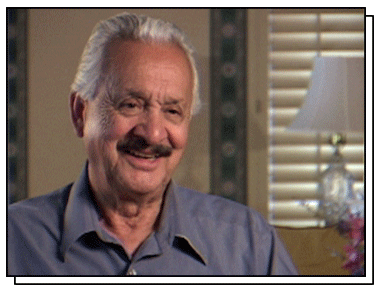
Gilbert Padilla
Gilbert Padilla was born in 1927 in a labor camp near Los Banos,
California. The child of migrant farm workers, Padilla traveled with his
family throughout California, picking cotton, tomatoes and fruit.
In 1945 Padilla was drafted into the U.S. Army; his five
brothers also served in the military. Despite records that included
numerous commendations, the returning veterans found their jobs gone, and
felt treated like outcasts rather than heroes. That anger fueled what
became Gilbert's lifelong work: Organizing Mexican-American workers to
assert their rights.
In 1956 Padilla met Cesar Chavez, who was an organizer
for the Community Service Organization. "Gilbert was my discovery,"
Chavez would later tell an interviewer. For the next eight years Chavez
and Padilla worked together in CSO, conducting citizenship classes and
voter registration drives, battling police brutality and
discrimination and fighting for many issues: pensions for non-citizens, immigrants' rights,
and disability insurance for farm workers. When Chavez quit as
director of CSO in 1962 and began to organize farm workers, Padilla joined
the effort. For 18 years, Gilbert helped build the United Farm Workers
Union, serving as secretary-treasurer from 1973 until 1980.
In 2005 Gilbert began the CSO project to document and pass on the lessons that
empowered an entire generation of Mexican Americans and changed the course
of history for their children.
Alex Zermeno
Alex Zermeno's first exposure to the power of organizing came as a high
school junior in Soledad in 1953 when a Mexican teenager was accused
of killing the son of a local farmer. Through a house meeting campaign,
the local CSO chapter helped the accused boy's parents gain visitation
rights and then hire a lawyer. Ultimately, no charges were filed. Soon
after, Alex was recruited by the local CSO leader, who pushed Alex to think about the role of Latinos in the history of California, and who helped him to become a leader.
Alex and his family became leaders in the Monterey County CSO chapter,
which conducted voter registration drives and fought for housing,
sidewalks and street signs for their communities. Zermeno graduated from San
Jose State University and then received a Masters of Public
Administration from Harvard University. He served as deputy director of the
National Council of La Raza and was a founding member of the Oakland Unity
Council, serving on that board for 15 years. In 1992 Zermeno was
appointed to the
Human Rights Commission of Contra Costa County. He was one of the
founders of the Hispanic Leadership Development Committee of United Way and
the Bay Area Latino Non-Profit Association, and a member of the Civil
Rights Network. And, remembering the lessons of his own youth, Zermeno
has served as volunteer for the Chicano Latino Youth Leadership
Project in the Bay Area.
Luis Zarate
Luis Zarate grew up following the crops in Santa Clara County, managing to stay in school even while he lived in tents and under water towers. After serving in the Navy and graduating from Santa Clara University, he worked as a probation officer in San Jose in the same office as Herman Gallegos. At Gallegos's urging, Zarate went to his first CSO event and helped Cesar Chavez sell Christmas trees as a fundraiser for CSO. Zarate was skeptical about CSO, but when he realized how dedicated this organization was to making significant changes, he decided to join. "The seeds of discontent were there over the many, many years of issues related to my own identity as a Mexican American," Zarate said. At that time, CSO was working to improve conditions in Sal Si Puedes, where residents couldn't get out of their homes when it rained because the streets flooded. Zarate used the lessons he learned in CSO to organize several other groups, always remembering Saul Alinsky's advice: Find the issue. Zarate founded the Probation Officers Union in Santa Clara County and the Guadalupe Washington Neighborhood Association. He also served on the National CSO board, the local school board, the Governor's Advisory Committee on Children and Youth, the Human Relations Commission of the City of San Jose, and the Civil Service Commission.