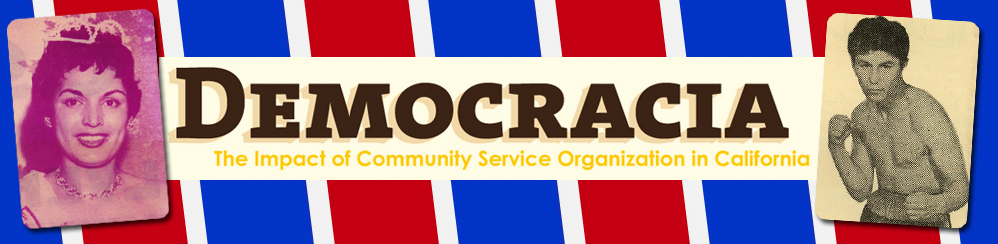
In the summer and fall of 2012, three forums CSO will be held in San Jose, Hanford and The Imperial Valley, all sites of CSO chapters. In addition information and resources on CSO activities in 11 other counties where CSO chapters existed will be distributed.
Democracia will also provide a rich web based resource for all Californians Through community resources and archival materials,
Democracia will highlight the successes and struggles of local heroes. The project hopes to inspire a new of activists interested in putting democratic prinicples into action and effecting change on a local, state and national level.
This project was made possible with support from the California Council for the Humanities, an Independent non-profit organization and a partner of the National Endowment for the Humanities. For more information, visit
www.calhum.org
Check back soon for information about the forum locations and the
Democracia website launch
CSO Update ~ March 2011
Dear CSO supporters,
The CSO project leadership team would like to share with you some of the interest and work generated over the last year by the UCTV video and CSO website. Every month we hear from individuals and institutions across the country interested in CSO. Below is a brief update.
- Organize! The Lessons of the Community Service Organization (which premiered on University of California Television last year) is a 90 minute documentary that includes clips from the CSO Project oral history interviews, the 2008 Asilomar conference, and other CSO historical materials. Watch it now at http://www.youtube.com/watch?v=hzMaR0fspdk.
- Dissertation: Southwest Council of La Raza: Carmen Samora, a graduate student at the University of New Mexico, is doing her dissertation on three unsung founders of the Southwest Council of La Raza: Herman Gallegos, Ernesto Galarza, and Julian Samora (her father). She utilized the CSO film and other resources on our website in her research.
- Boyle Heights Documentary: Director Betsy Kalin of East LA Interchange used some of our archival information for a film, which is currently in progress and nearing completion.
- CSO archival information researched in Chicago: Last fall I spent time in libraries at the University of Chicago and the University of Illinois, at Chicago researching CSO. The University of Chicago holds the Emil Schwarzhaupt Foundation archives which is rich with CSO information and the Saul Alinksy files at the University of Illinois, Chicago. Both provided valuable historical information on CSO.
- Encyclopedia of Cesar Chavez: Photo researcher Liz Kincaid is working on an Encyclopedia of Cesar Chavez and is including a section on the CSO. We put her in touch with Fred Ross Jr, to get licensing rights to a picture of his father.
- CSO Thesis: David-James Gonzales, a UCSD history student, is writing his thesis on the CSO and will also cover Hector Tarango and the desegregation of Orange County schools. He is utilizing our interviews and archives in his research.
- Humberto Garza's book: Humberto Garza has published his account of CSO. Gilbert, Herman spoke extensively with Humberto while he was writing the book. The title is: "Organizing the Chicano Movement, The CSO Story" (available for purchase at http://www.joaquinmurrieta.net/chicanomovement.html). If you want a copy, you may also contact Humberto at humbertogarza_2010@yahoo.com.
- Book being written about Fred Ross: Gabriel Thompson is writing a book about Fred Ross. Gabriel has worked as a community organizer and published two previous books, one on community organizing -Calling All Radicals: How Grassroots Organizers Can Save Our Democracy (Nation Books, October 2007) and another on Mexican Immigrants, There's No José Here: Following the Hidden Lives of Mexican Immigrants (Nation Books, January 2007).
- Cesar Chavez Breakfast honoring Gilbert Padilla: At the end of this month, the Cesar Chavez service clubs in San Diego will honor the life and work of Gilbert. We will be there to celebrate with him.
I hope you find it as gratifying as I do to see the story of CSO being told through so many venues. If you have
comments or other updates, we'd love to hear them. Feel free to contact our office at (858) 534-9154 or at cjimenez@ucsd.edu.
Gretchen Laue, member of CSO Project Leadership Team
NEW! Ed Roybal Speech
Students and faculty from the Ed Roybal Learning Center attended the CSO conference at Asilomar in fall 2008. Debra Coaloa, an Assistant Principal at Roybal, asked Edward Roybal Jr. to be the commencement speaker at the high school last year. Here is his speech.
CSO Documentary
WATCH ONLINE NOW!
Organize! The Lessons of the Community Service Organization premiered on UCTV March 29. It is now available for viewing any time online at http://www.youtube.com/watch?v=hzMaR0fspdk. Organize! is a 90 minute documentary that includes clips from the CSO Project oral history interviews, the 2008 Asilomar conference, and other CSO historical materials.
Project Introduction
More than five decades ago, in colonias and barrios across California, Mexican-American men and women made history. They were workers and housewives, recent immigrants and returning soldiers. They toiled in the fields and on the railroads, in construction and in service jobs. For many years, they experienced racism and discrimination, and they believed they had no power to change the status quo. But through a unique experiment, they discovered otherwise.
That bold experiment was the Community Service Organization, a grassroots organizing effort that empowered a generation of Mexican-Americans and changed the course of history for their children. Through voter registration drives, citizenship classes, lawsuits and legislative campaigns, CSO enabled poor immigrants to make demands on the political system and to move into the mainstream of American society.
The CSO Project was formed to capture the stories of the pioneers whose work in the 1950s marked the beginning of the Chicano civil rights movement. Through this website and a range of other media - including archival collections, oral histories, a landmark CSO conference, and a book — the project will probe the organization's successes and failures in order to pass its lessons on to future generations.
The alumni of CSO include famous figures, such as former U.S. Rep. Edward Roybal, the first Mexican-American elected to political office in Los Angeles, and Cesar Chavez, who learned to organize in CSO and went on to apply those lessons to building a union for farm workers. But the real story of CSO is about thousands of men and women who learned to hold house meetings, conduct voter registration drives, protest police brutality, and bring evening citizenship classes to neighborhood schools.
It is the story of Juan Govea, who worked for the Santa Fe Railway by day and labored at home each night to translate the Department of Motor Vehicles manual into Spanish, and his daughter, Jessica, whose childhood experiences as a "CSO kid" propelled her into the leadership of the United Farm Workers. It is the story of Hector Tarango, who in 1948 made history in Orange County by winning the first school desegregation case in the country.
At a time when a nascent immigrant rights movement struggles to overcome prejudice and combat the growing economic divide in the United States, building organized communities that engage in civic participation is more important than ever. The lessons and legacies of the CSO model can provide a catalyst for action today.